The Story of the Painting

The Story of the Painting

Every year I bring a small group of cooks and travelers to Italy. Often we go to Venice. Why? The list of whys is very long. People think of Venice has “too many tourists”— but the city and its charms are way bigger than that. My favorite person and chef in Venice is Chef Marika Contaldo Seguso. All of my groups have cooked with her in her villa on the Lido. We’ve toured and shopped with her at the great Rialto Market, we’ve boated deep into the outer lagoon to visit where local fisherman set up nets, we’ve explored the outer islands of Torcello & Burano, and have hiked through a vegetable farm island, Vignole, harvesting artichokes and picnicking within the crops. She is the best person you’ll ever (ever) want to know. I learn so much from her and just love to be in her company.

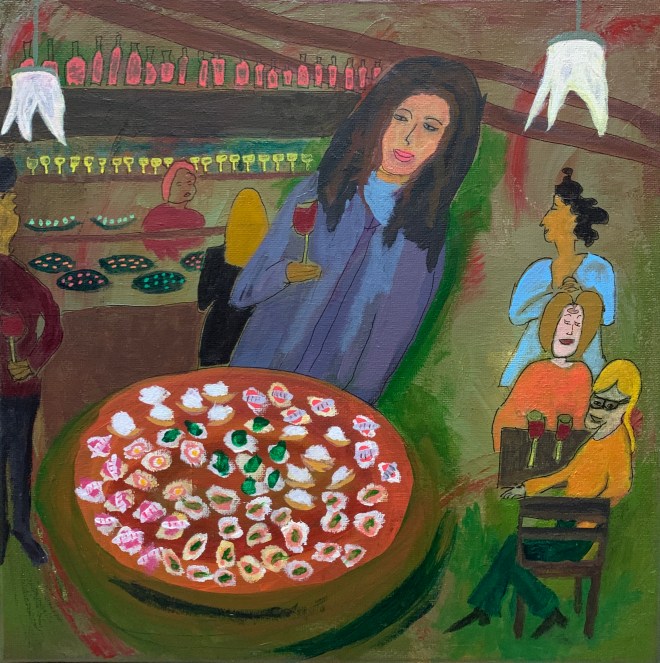
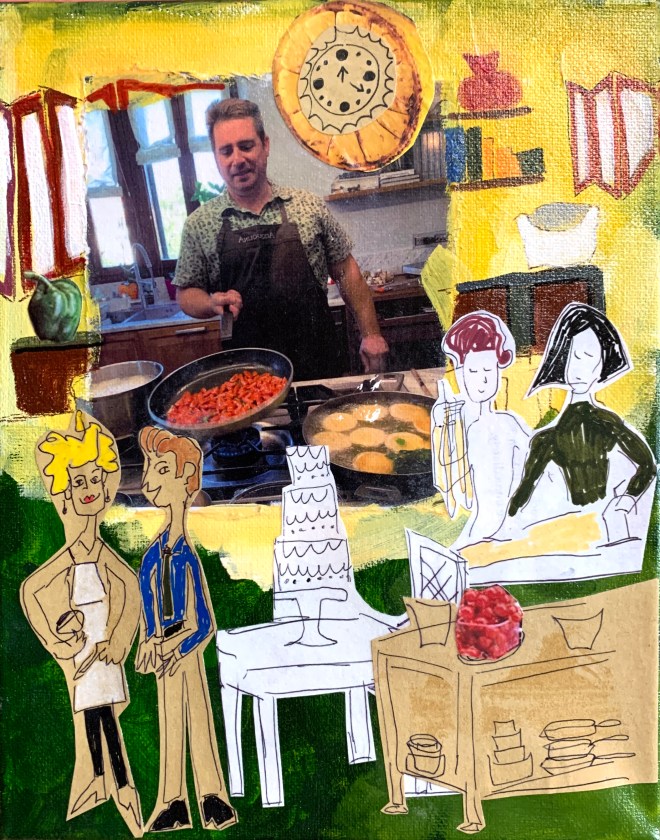
This painting is an impressionist/folk interpretation of Marika. Here we are at the oldest bacaro/wine bar in Venice: Cantina do Mori. Whenever we visit, Marika orders special wines for us and has the proprietor assemble a huge tray of assorted “cicchetti”…it’s one of my favorite “food moments” in Venice.

Follow Marika at https://www.instagram.com/villa_ines_venezia/

Painting available at Galerie Tangerine

The Story of the Painting

hot chocolate con panna” …The Story of the Painting

“It was a cold and rainy night.” Well, actually a cold and rainy morning in November 2019. We were on our way to Valdobbiadene with our wine guide from Venice Day Trips, Mario Piccinin. We met him at the Tronchetto stop on the vaporetto, the first stop just outside of Venice proper where a passenger van could pull up.

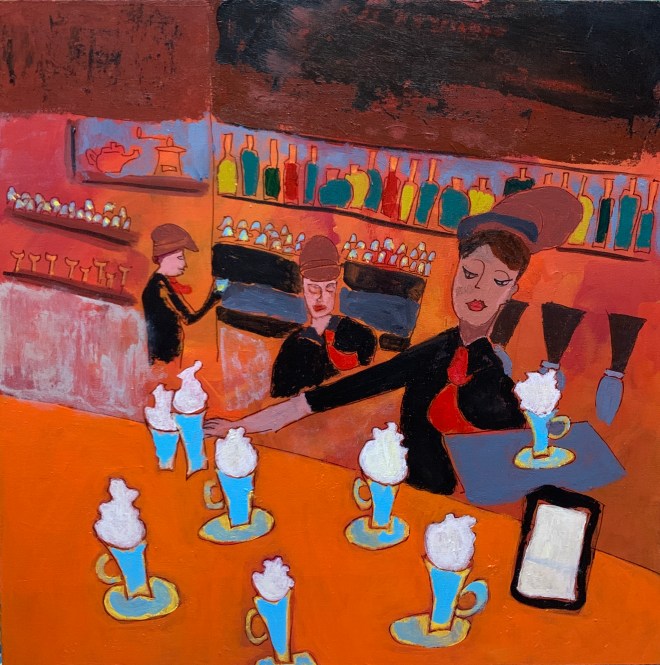
On the way Mario stopped at a freestanding cafe/bar/chocolatier, in a small residential town, to get a halfway-there coffee. One side of the cafe was filled with displays of pretty boxes of chocolates, sweet treats, and highly decorated cakes. The other side had a few tables and a bar counter, bustling with customers. Mario said, “You should try the hot chocolate.” We did. They arrived piled high with sculpted whipped cream. AMAZING. The beautiful servers behind the bar wore wide red ties, black shirts, and brown floppy caps. Just another perfect experience when traveling in the Veneto. @pasticceriabotter

I’m thrilled to have this painting included in the Galerie Tangerine Holiday Salon Show. It’s one of four of my works in the show. View them on the Galerie Tangerine “store” page: Galerie Tangerine Store

Venezia & Beyond

My traveling group in Padova and Venice

May 2025 I led my 11th group trip to Italy with friends and students from my cooking classes. I always keep the group to no more than 8 (altho the very first time I took a group to Venice we were 11!). And this was 5th group trip to Venice. It seems I can’t stay away from this place. Venice has so much to offer: its food, its art, its architecture, its people and the chefs and tour guides I’ve come to know and love. But the over-arching stellar aspect is Venice itself. A glimmering city set in a blue lagoon.

On this trip we started by spending some days in Padova, just 30 minutes from Venice. This is a jewel of a town. With Venice Day Trips we toured the city, nibbled at the food market, saw where Galileo taught, and went into the countryside for wine and cheese tastings at artisan producers.

In Venice, we absorbed the lovely city, staying in the sestiere of Dorsoduro, and taking the vaporetto to San Marco, Rialto, and all points. Water taxis picked us up right at our lovely hotel to visit outer islands, Vignole, San Michele, Murano, the Lido. We spent 2 wonderful days with my favorite chef in Venice (my favorite chef, period), Marika Contaldo Seguso of Acquolina.

Marika Contaldo Seguso

First day we visited an island farm, where the farmer took us around, harvesting as went. We saw the verdant new baby artichokes, sweet peas, zucchini, zucchini flowers, beets, lettuces, and radishes. We cooked all these vegetables together at Marika’s kitchen.

On our second day with our chef, we toured the Rialto Market, and brought back bags and bags of lovely seafood to cook.

Marika’s husband, Gianluca Seguso, is part of the centuries-old glass-making family: Seguso 1397 (that’s the year they began). We toured his impressive high-art furnace and gallery on Murano.

Gianluca Seguso

Every time I start to plan a trip for Italy, thinking of where to bring my enthusiastic cooks and travelers, Venice seems to pull me back like a magnet. I’ve toured with my groups to Puglia, Rome, Florence, Parma, Sicily, and the Amalfi Coast. Where will we go next time???

In San Marco


Italian-Language Magazines & Cookbooks

I’ve been a fan of Italian-language food magazines since the 90’s. Of course, I’m in love with Italian food, but my fever for these magazines was originally sparked by airport spending sprees, getting rid of a few leftover lire/euros at the end of an Italy trip. At the airport I’d collect two or three or four Italian food magazines. The pictures alone absorbed my attention for the trip home.

My first love: the magazine “La Cucina Italiana” (there’s an American version, but my heart stays with the Italian one). It’s the most beautifully produced food magazine ever. Like an Architectural Digest of Italian food. I’ve cooked dozens of recipes from these magazines, translating with an Italian-English dictionary by my side. I’ve saved some of these issues for decades.

When I lived in NYC, Rizzoli Bookstore on 57th Street had a back room filled with foreign magazines and newspapers. I’d stop in weekly to look for the new “La Cucina Italiana” or “Sale e Pepe” or the charming small booklets “GuidaCucina,” which gave you weekly menus to cook.

I’ve recently discovered a company that imports foreign magazines and you can subscribe to a couple of Italian food magazines. I just got a subscription to “Sale e Pepe” (Salt & Pepper). Take a look here: MagazineCafeStore

I also have a treasured collection of Italian-language cookbooks (sometimes they are in Italian & English). Each time I visit a region I look for a regional cookbook and dive in to learn new recipes when I get home. Teaching Italian cooking classes gives me more inspiration to bring authentic dishes to my cooking students.

The cookbook, “Liguria in Bocca,” is from a stellar series of regional Italian cookbooks (one for each region, in dialect and in Italian). It was given to me by one of my heroes of Italian cooking, Bianca Cingolani Podesta. I met her in 1995. She was a cousin of my then-husband, Peter, and we visited the family at her pink villa high in the Ligurian hills. Her grandfather had built the lovely villa (Villa Bianca, now available for rental), and she called it her “paradise, and her prison” — why? Because she can never leave. Its beauty tied her to it.

During our month-long stay, I followed her around the kitchen as she cooked the specialties of the region, everything from rabbit to pesto to cherry desserts, and more. It’s when I started my glossary of Italian cooking terms to help me read Italian recipes.

Italian-language cookbooks or magazines give you an insider understanding of Italian cooking sensibilities that you can’t get from interpretations of Italian recipes here in the States. You learn how specific ingredients are really important — how they are used — and that there is, I want to say “restraint” —when cooking simple dishes to perfection. The Italian-American trope of “abbondanza” is not necessarily connected to authentic Italian cooking. Abbondanza, yes, in the sense of generosity of variety, but not in spilling-over-filled dishes, or extra extra cheese, or over-saucing pasta dishes.

I hope you, too, will take the adventure to discover Italian food periodicals or cookbooks. Just a bit of Italian vocabulary will give you a beautiful sense of authenticity. The publications are little gems you’ll want to safeguard and keep.

Lentils are Coins: Let’s Eat a Million

Close up of Lentils

Lentils

When I lived in Rome my Roman roommate (and soul sister), Enrica, made lentils for lunch one day. In Italy you can get lentils in a can, pre-cooked, like you buy baked beans here. They’re called lenticche in Italian. Enrica emptied the can into a small saucepan and heated the lentils. Then in a small saute pan she heated a little olive oil, added a garlic clove, and cut a few slices of bread into small triangles and fried them to crispy. We each sat down to a bowl of hot lentils topped with crispy garlic croutons. It was, actually, heaven in a bowl.

Lentils are adorable. Have you ever really looked them over? What a sublime invention of nature. So it’s no surprise to me that they represent the possibility of good fortune and prosperity. That they are the go-to traditional meal of New Year’s Eve in Italy. That they are the little horn-blowers to ring in the new year and make everyone rich (well, if not in moneta, in spirit).

On that night, lentils are also accompanied by sausage or cotechino or zampone. To make my life easier I just go for the Italian sausage (already made, bought at the store).

The resulting concoction (of supposedly homey and unsophisticated ingredients) is downright exciting. You feel you are finally having the meal that your body is craving and that your soul scurries up from the depths of you rushing like a very happy puppy for the mana you have (finally) fed it.

If lentils resemble coins, and therefore symbolize the potential for a bigger bank account, well, then, all the better.

Here’s how I make this Happy New Year treat (note: any ole time is perfect as well).

Ingredients

Ingredients

Peel two carrots and slice into rounds. Cut 2 stalks of celery into half-moons. Peel an onion, cut it in half and cut into thin half moons. Saute this mirepoix in a couple of tablespoons of hot olive oil in a medium saucepan.

Mirepoix sauteing

Mirepoix sauteing

When softened, add 2 cups of rinsed lentils. Let them get coated and hot. Add a 1/2 cup or so of dry white wine. Let it evaporate. Then add 4-5 cups water (or broth). Stir, season with salt & pepper. Add a little aleppo or crushed red pepper flakes.

All in the pan

All in the pan

Let simmer for about an hour or so until lentils are soft. I partially cover the pan.

When done add a small 8-oz can of “tomato sauce” the kind you can just buy or any tomato sauce you have. Simmer a few minutes more.

Contadina tomato sauce

Contadina tomato sauce

Meanwhile, heat about an inch of water in a medium saute pan till boiling. Add 3 Italian sausages. Poke them with a knife in a couple of spots. Let them cook, with water simmering, until no longer pink.

Sausage in pan

Sausage in pan

Let water evaporate and add just a bit of oil and let sausages brown and cook through. Place pan under broiler if you like for more browning. When done, cut into rounds.

Golden Sausage

Golden Sausage

I have to add the Enrica part, too. In a small saute pan (or use the pan the sausage cooked in using the leftover oil) heat some olive oil. Add a couple of peeled, smashed garlic cloves. Then add a couple or three slices of bread cut into small triangles or squares. Saute till golden and crispy.

Croutons

Croutons

Put it all together: In each serving bowl, add a couple of ladles-full of lentils, a few rounds of sausage, a sprinkle of croutons, and (optional) some fresh minced sage. Grated pecorino is a nice topping at the table, but it’s perfectly lovely without.

Happy New Year!

A serving of lentils
A serving of lentils

How to Enjoy a Zoom Cooking Class

Have you ever been in a Zoom cooking class? If not, it might be hard to imagine how it works. When I first started teaching Italian cooking over Zoom, I wasn’t sure myself! But I figured it out. You cook in your kitchen. I cook in mine. I demonstrate every step of each recipe. You follow along each step of the way. We have so much fun in these classes!

First I create a menu for us— all authentic Italian recipes (and sometimes other cuisines). I make sure it will take us no more than 2 hours to cook. I send a notice of a date and time to my class announcement list (and post on this website and social media). When you sign on, I send you the ingredient list. At class time, everyone logs in with the Zoom invitation. Suddenly we’re altogether on the screen. Ecco!

We start cooking together and finish cooking together. I go through every step of each recipe in real time.

We’re chopping vegetables and aromatics, sautéing soffritto, meats, and seafood, mixing batter for cakes and cookies, making dough for pasta, pies, and pizza.

We do every step together. And I give you lots of pointers and tips along the way. We cook together. We laugh together. Questions are always welcome. I give special attention for dietary needs and substitutions.

I hope you’ll join me for a Zoom class soon. You can log in from any place in the world! I have one coming up on September 26th…but you can always check my Zoom class tab to see what’s new: Current Zoom Classes


The Thrill of a Diner

Breakfast at El Mar

For all of my excitement over Italian cooking (and all Mediterranean cooking) I literally get a thrill when I’m sitting in a booth perusing a diner menu.

I grew up with the cooking of my Mom, dishes that were decidedly Italian, but the American side of my palate swoons for diner food.

The diners I knew in NY were often run by Greek-Americans, so in addition to eggs/sandwiches/salads/platters/burgers/etc., the menu sang with fabulous Greek dishes (which I loved), spanakopita, moussaka, pastitsio, souvlaki– what a great combo menu!

On a recent visit to Florida, to hang out with Duane’s brother Kurt (who lives in Fort Lauderdale), we dreamed of returning to El Mar diner. This cozy diner run by two sisters is perfection. How a plate of their eggs and home fries can light up the taste buds.

In Nashville, Wendell Simth’s (known as a meat ‘n three) fills the diner yearning with their complete menu. And so does Noshville, who puts a Jewish deli spin on diner. And then there’s Brown’s Diner, of course! It’s where Duane & I play music as “Duette.” Brown’s wasn’t exactly a diner, more a bar with burgers, until just recently. Now it has the full diner menu. Perfect.

Wendell Smith’s


Duette at Brown’s Diner

Noshville’s Matzah Ball Soup

People often ask me where are my favorite places to eat. I think because I’m a chef they’re expecting me to name the top best chef restaurants in Nashville or New York. My wheels start spinning trying to think of an answer. Sure, I love a bunch of chef-driven places, but the soul of my desire just wants to go to a cook-driven diner!

Zucchini Flowers How-to

Zucchini Flowers! The delicate yellow beauties of the zucchini plant.

My cooking-at-the-farm day at Green Door Gourmet with Arts Bellevue was a blast! One of the stand-outs was clipping zucchini flowers out in the farm.

Sylvia Ganier, Green Door Gourmet proprietor, gave us a farm tour and showed us how to choose and clip the flowers. A wonderful experience for all. Back in the kitchen, we cooked the flowers with this simple recipe and it was the hit of the menu!

Broccolini — Couldn’t be easier!

For YEARS I passed by broccolini in the produce department. It had an imposter air about it. Not broccoli. Not broccoli rabe. Not baby broccoli. Not baby broccoli rabe. So what is it? How come it’s got an Italian “ini” at the end. It’s not Italian.

I found out it’s actually a hybrid between broccoli and Chinese broccoli. That got me interested.

I bought some, took it home, trimmed it, and cooked it just following my own instincts. Similar, actually, to the way I cook broccoli rabe. But broccolini stems are a little denser, so are the florets and leaves — so I cooked it a little longer…

…and loved it! It has a milder, almost sweeter flavor compared to broccoli. And it’s not bitter like broccoli rabe. It’s a third “broccoli” with an assertive personality all its own. Welcome, broccolini, to my table. Try my recipe — easy!

Sautéed Broccolini with Slivered Garlic (serves 4)

1 bunch broccolini
2 garlic cloves
Olive oil for sautéing
Salt & pepper to taste

Trim the ends of thick stems from broccolini, about 1-2 inches, and discard. Spilt the stalks lengthwise so they’re not too thick. Cut the tops into long-to-bite-sized pieces. Peel garlic and cut cloves into long slivers.

In a medium frying pan, heat 2 tablespoons olive oil. Add the broccolini, and stir to coat in oil and cook for 1-2 minutes at a lively saute. Add garlic, cook for 2 minutes. Add 1/4 cup water. Let broccolini steam-saute, lively, until tender, about 3-4 minutes. Season with salt & pepper.

Additions/alternatives: add some red pepper flakes if you’d like a little heat. Add some lemon zest for a citrus pop.

Sicilian Roots

My grandparents from Ragusa

I had such a blast chatting recently with Andrew Gebby and Giovanni Franceschini on their Sharing the Flavor podcast. We jumped into the subject of Sicilian roots. Andrew’s grandfather came from Messina, and my paternal grandparents came from Ragusa– and maternal grandmother was from Palermo. Being second generation American sometimes feels like we just got here from a foreign world.

A few years ago I led a group of my cooking class students on a tour of Sicily, and we spent time in Ragusa. The people we met, the foods we ate, the places we were, and the air we breathed, were, to me, so familiar. Whatever my family brought back to NY, the traces of life lived in Sicily, all blended together for a grand meeting — Sicilian-American me embraced by origins of me.

San Giorgio in Ragusa

Of course, the biggest sensory connections happened with food. My dad was famous for his “scaccia.” I grew up eating this unusual rolled stuffed pizza lightly filled with tomato sauce, cacciocavallo cheese, and basil leaves. It was as familiar as pasta fagioli, but nowhere to be found at any Italian-American restaurant, or any Italian-American household I knew.

Dad’s Scaccia

On my first day in Ragusa, having coffee at a bar, I spotted a piece of scaccia in the panini showcase and blinked and blinked unsure what I was seeing. I ordered it immediately and on first bite was sent to the moon. Yes. This is my Dad’s scaccia. Here. Thousands of miles away. But not far, really, from his parents who walked these same Ragusane strade.

Scaccia at bar in Ragusa

These stories and more all come out in our podcast discussion deliciously focused on Sicily. Here’s the link: Sharing the Flavor …It’s a fun way to immerse in Sicilian experiences. All the dishes and recipes we talk about are at the bottom of this post. I hope so much you will try them out. Let me know how it goes. And by all means, contact me with any questions. Buon viaggio!

Dad’s Sicilian Scaccia 6 pieces
For the dough:
5 cups flour (all-purpose)
2 teaspoons salt
2 1/4 teaspoons yeast (1 package/envelope)
1 teaspoon sugar
1/4 cup olive oil, plus more to coat dough
1 egg, beaten

For the filling:
1 small onion, peeled and diced
olive oil for sautéing
1/4 cup white wine
28 ounces crushed tomatoes
salt & pepper to taste
1 lb. provolone cheese, cut into 1-inch thin slices (or caciacavallo if you can find it)
1 cup basil leaves

In the bowl of a stand mixer (or you can do this by hand) mix together the flour and salt. In a medium bowl or large measuring cup combine 1 1/2 cups warm water (tepid, not too hot, not too cool) with the yeast and the sugar. In a small bowl or cup mix the egg with the olive oil. Make a well in the center of the flour. When the yeast has “bloomed” (becomes puffy) pour the yeast water in the well and pour the egg/olive oil mixture in the well. Gently stir the flour and wet ingredients to roughly combine. Then mix on a slow speed with the dough hook for about 5 minutes until silky.

Take out dough hook. Smooth a thin film of olive oil over top of dough. Flip dough so all sides have a thin film of olive oil. Cover top of bowl with a clean dry kitchen towel and place in a draft-free place to rise. Let rise about 2 hours. It should double in size. Scoop dough out onto a work surface and cut into 6 pieces (use a bench scraper or knife). Roll each piece gently into a ball and wrap each ball in a pam-sprayed or lightly oiled piece of plastic. Don’t wrap too tight since dough will rise again in plastic. Let rise about an hour more.

Make the sauce: Heat a little olive oil in a medium saucepan. Add the onion. Sauté until wilted and softened, about 3 minutes. Add the wine, let evaporate. Add tomatoes. Stir to combine. Season with salt & pepper. Simmer for 10 minutes. Remove from heat, let cool to room temperature.

Cut the cheese into small thin slivers. Preheat oven to 425 degrees F.

Unwrap dough and gently press out the dough. Using a rolling pin, roll out an thin oval. Just below the center of the oval smooth a few tablespoons of sauce, across the width of the dough, sprinkle some thin slices of provolone cheese, and a few torn basil leaves. Lift the bottom border of dough over the filling, add more sauce, cheese and basil. Fold over again, and repeat one more time. Pinch to seal all around. Place on a parchment-lined sheet pan and bake for about 30 or until golden. Let sit for a few minutes before cutting into 2-inch slices. Serve warm or at room temperature.

Ragusa Scaccia- Stuffed Pizza w Tomato & Cheese 4 pieces (from Ragusa)
For the dough:
3 cups semolina, fine ground, plus more for bench flour
1 teaspoon salt
1 tablespoon olive oil
1 package yeast (2 1/4 teaspoons)
1/2 cup warm water

For the filling:
1 small onion, peeled and diced
olive oil for sautéing
1/4 cup white wine
28 ounces crushed tomatoes
salt & pepper to taste
1 lb. provolone cheese, cut into 1-inch thin slices (or caciacavallo if you can find it)
1 cup basil leaves

Whisk flour and salt to combine. Drizzle olive oil on top. Mix yeast with warm water, wait 2-3 minutes until yeast blooms. Make a well in the center of the flour and pour in yeast water. Mix gently with your hands, moving the damp flour between your fingers. Add 2/3 to 3/4 cup more water. Mix until dough starts to form, then start kneading to bring it together. Knead until a smooth dough forms, about 5 minutes. Break into 4 pieces. Roll each into a ball. Place in a draft-free spot covered with a few layers of clean kitchen towels. Let rise 1 hour.

Make the sauce: Heat a little olive oil in a medium saucepan. Add the onion. Sauté until wilted and softened, about 3 minutes. Add the wine, let evaporate. Add tomatoes. Stir to combine. Season with salt & pepper. Simmer for 10 minutes. Remove from heat, let cool to room temperature.

Cut the cheese into small thin slivers. Preheat oven to 425 degrees F.

Roll out one of the dough balls as thin as possible. (less than a 1/8”) Spoon a thin layer of sauce in the center, across to the edges. Add some cheese pieces and a couple of basil leaves. Fold over the top to the center. Spoon little sauce on top and add a few pieces of cheese and a basil leaf. Fold over the other end and repeat. Fold 2 sides in and add sauce and cheese. Fold to close like a square package. Repeat with the rest of the dough. Place scaccia on a parchment lined baking pan. Bake for about 30-40 minutes until golden and charred in spots. Cut each scaccia into squares and slices. Serve.

Trapanese Pesto (Almonds, Tomatoes & Basil) (from Palermo)

3 small ripe tomatoes
1/2 cup almonds without the peel (whole or slivered)
2 garlic cloves, peeled & halved
1/2 cup fresh basil leaves AND MINT
1/4 cup grated pecorino cheese (plus more for serving at the table)
approximately 1/3 cup olive oil
salt & pepper to taste
1 lb. Fusilli or favorite cut pasta

Bring a medium saucepan, halfway full of water, to a boil. Cut out the stem mark from each tomato and cut a superficial “X” at the bottom of each tomato. Drop tomatoes into boiling water. Let sit for about 1-2 minutes. Lift out with a slotted spoon into a bowl. Run cool water over tomatoes. Drain.

Peel skin off of tomatoes. Cut them into quarters and push out the seeds from all the tomato quarters. Discard seeds and skins. Cut tomato quarters into about 3 pieces each. Place in a bowl and set aside.

Place the almonds and half of the garlic in the bowl of a mortar and pestle. Pound and press the almonds and garlic, breaking it down to small pieces and pulpy. As you work, add basil leaves a little at a time, pounding into the mixture. You want to get it finely mashed but small chunks are okay. Drizzle a little olive oil. Add the rest of the garlic and basil leaves, pound until broken down fine. (Alternatively, use a food processor. Don’t over-process…break it down so that you can still see tiny pieces of almond.)

Meanwhile, set a pasta pot of water on the heat to boil. When boiling, add a generous amount of salt. And add pasta. Stir until the water comes up to a boil again.

Scrape the pesto into your serving bowl. Add 1/4 cup of grated pecorino. Season with salt & pepper. Add a couple of spoonfuls of pasta water. Mix to combine. Add a drizzle of olive oil. Add the tomatoes. Press tomatoes slightly with a potato masher, leaving a lot of chunks, too.

When pasta is done, scoop a cupful of pasta water and reserve. Then drain pasta. Mix drained pasta with the pesto. Stir to coat and combine. Drizzle a little olive oil. Add a little pasta water if the mixture is dry. Serve, passing extra grated pecorino at the table.

Almond Cookies Dipped in Crushed Almonds w Candied Cherry (from Palermo)

2 cups almond flour
1 cup sugar
1/4 teaspoon orange or lemon extract
3 egg whites
1 cup sliced almonds, crushed (I put it in a ziplock bag and press with my fingers to crush)
1 dozen candied or maraschino cherries, quartered

Preheat oven to 400 degrees F.

In a medium mixing bowl, whisk together the almond flour and sugar, with a fork. Stir in the extract and egg whites and mix until a dough forms. Knead lightly to combine. Dough will be sticky. Place crushed almonds on a flat plate. Pull off a small amount of dough and roll into a 1-inch to 1&1/2-inch ball. Roll each ball in the crushed almonds, place on a parchment lined sheet pan, gently press a piece of quartered cherry on top of each. (makes about 1 dozen or so). Bake for about 12 minutes until golden.

Almond Cookies baked on a boat in Palermo harbor